FILM
The Father: A Film That Rewards Looking Twice
Spoilers throughout for Florian Zeller’s The Father (2020)
The first time I watched The Father, I felt lost, which is exactly what it wants. By the end I wasn’t sure which flat I was standing in, which face belonged to which character, or what day it was. Zeller has spoken about wanting the audience to feel that disorientation from the inside, rather than watching it from a comfortable distance. On me, it worked completely.
So I watched it again. Then I read the screenplay, written by Zeller and Christopher Hampton, with a pen in my hand.
I expected the second look to solve the film, to reveal a clean timeline underneath the confusion. It didn’t. It showed me how carefully the confusion was built. The Father is not a puzzle with a hidden answer. It’s designed so that almost every clue points two ways at once. And its boldest move isn’t anything it does to Anthony. It’s what it quietly gives his daughter.
A Flat That Won’t Stay Still
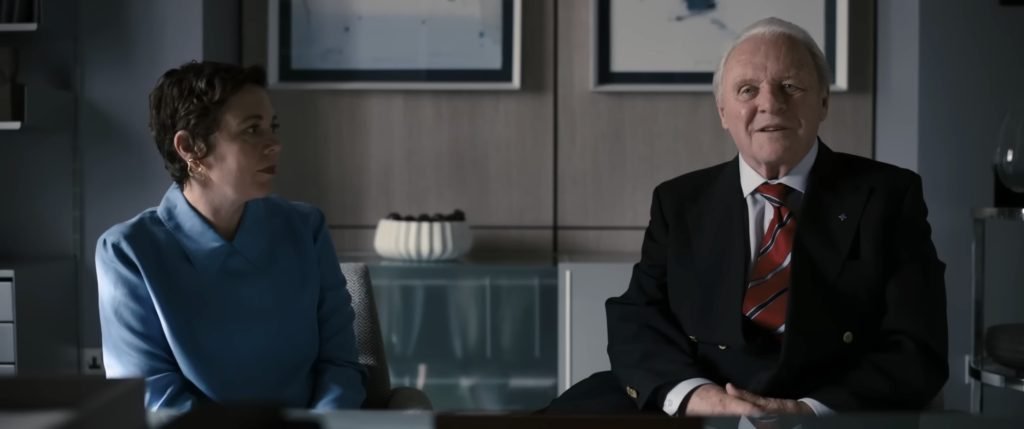
Anthony, played by Anthony Hopkins, lives in a large London flat. He’s proud, funny, charming when he chooses to be, and cruel when he’s frightened. His daughter Anne, played by Olivia Colman, keeps hiring carers, and he keeps driving them away. He insists he can manage on his own.
What he really depends on is the flat. When he tells Laura, the new carer, that he bought it more than thirty years ago, he isn’t making conversation. He’s defending the one thing that still tells him who he is.
Then the flat begins to betray him. A stranger sits in his living room, saying he lives there. Anne says Anthony moved in with her. The kitchen walls are a different colour. A painting disappears, and Anne says there was never a painting at all.
The trick behind this is almost embarrassingly simple. The film was built largely on one set. Anthony’s flat, Anne’s flat, and finally the care home share the same doors, the same corridors, the same layout. Only the furniture, colours, and objects change. Even the doctor’s clinic seems to have the same entrance hall. When Anthony and Anne step out of a lift, he assumes they’re home and asks whether she’s lost her keys.
Later, the brightly coloured chairs from the clinic’s waiting room turn up in the hallway at home. Anthony asks where they came from. No one can tell him. The rooms of his life have started leaking into one another.
On a first viewing, this creates a feeling you can’t quite name. You just sense that something is wrong. Look again, and you see how much of that feeling was created by a set dresser moving a chair.
Faces That Won’t Stay Still
If the rooms shift, so do the people. At one point, a woman Anthony has never seen walks in, calls him “Dad,” and says she’s Anne. She’s played by Olivia Williams, not Olivia Colman. The man who claims to be Anne’s husband Paul is Mark Gatiss, and later Paul is Rufus Sewell. We know exactly as much as Anthony does, which is nothing.
Next time you watch, pay attention to how that unfamiliar woman behaves. She sits Anthony on his bed, calms him down, and hands him his evening pills. She’s gentle but practical, a little detached. That’s not how the anxious, emotional Anne behaves in the rest of the film. It’s how a carer behaves. And in the final scene, a nurse named Catherine, played by the same actress, does the same things.
Here’s a theory, and it is only a theory: Anthony may already be in the care home much earlier than we realise. The “strangers” in his flat could be the staff around him, pulled into his memories of home. The Woman is Catherine. The Man is Bill, the male nurse we meet at the end.
But the film argues back. In a later scene, Anne tells Paul, close to tears, that when she came home with the dinner, her father didn’t recognise her. From her side, that stranger was her.
So which is it? The film wants both to be true. The Woman is Anne, and the Woman is Catherine. How would Anthony know which? He can’t. And so we can’t either. That is what The Father is really about: not the answer, but the experience of being denied one.
Time That Folds Back on Itself
The rooms and faces aren’t the only things that won’t hold. Time doesn’t either.
At dinner, Paul complains that they had to cancel a holiday to Italy because of Anthony. Anthony goes to the kitchen for more chicken, forgets why he’s there, and walks back to hear Paul telling Anne that the doctor is right, that her father is ill. But we’ve already heard this exact conversation a few minutes earlier, when Anthony first approached the dining room.
We live the moment twice, the way he does. And the second time is worse, because now he understands who they’re talking about. It’s the scene where Anthony discovers he’s sick, and the film makes him discover it twice.
The screenplay confirmed something I had half-noticed on screen. Early on, Anthony walks into his kitchen and finds shopping bags on the table, with no idea who put them there. Much later, Anne comes home and sets her shopping down, and the stage direction specifies that the bags land in the exact position Anthony found them in. The writers deliberately linked two moments out of order. We saw the effect before the cause.
That’s how the whole film is edited. It doesn’t just show us a confused man. It arranges its scenes the way his memory arranges them.
What the Film Refuses to Show
Some of the smartest choices in The Father are about what it keeps from us.
When the stranger first phones Anne, we don’t see her side of the call. The film holds that back until much later. If we’d cut away to her early, we’d know too soon that there’s a stable world out there somewhere. Instead, we stay locked in Anthony’s point of view for longer.
The camera works the same way. It stays close to Hopkins, often in medium close-ups, and as his condition worsens, he’s more and more often half-lit, sitting in shadow in a chair or on the edge of his bed. The editing rarely rushes him. Long takes let the performance breathe, and you watch confidence turn into fear on a single face.
The music does something similar. The film keeps returning to “Je crois entendre encore,” an aria from Bizet’s opera The Pearl Fishers, in which a man remembers the voice of a woman he loved and can still almost hear. The film never explains why the song matters. It lets the memory in the music sit beside the memory slipping away on screen. At one point, even Anthony’s music skips, as if rhythm itself were slipping away from him.
All of this serves one rule: we stay with Anthony, inside his confusion. Which is what makes the one time the film breaks that rule so striking.
The Thought That Isn’t His
This is the moment that changed my reading of the film.
Late one night, Anne sits on the edge of her sleeping father’s bed. She strokes his cheek. Then her hands move down to his throat, and she begins to squeeze. The camera watches from a distance and doesn’t look away.
The first time, I assumed this was another of Anthony’s paranoid fears. He had already accused Anne of plotting to steal his flat, so a fantasy of her killing him seemed to fit.
It isn’t his. He’s asleep. The screenplay is plain about it: in the next scene, Anne is standing in the dining room, and she has been daydreaming on her feet.
That matters more than it first appears. Almost every distortion in The Father comes from inside Anthony’s mind. When he’s absent, the film usually feels steady and reliable. When Anne is alone with Paul, he’s always the same man; the stranger only appears when Anthony is there to see him. This is the exception. The one time the film bends reality outside Anthony, it bends it for Anne, and what it shows is a terrible, private wish.
I’ve never cared for someone with dementia, so I won’t pretend to know that exhaustion from the inside. But this scene says something no speech could: loving someone and wanting it all to be over can live in the same person at the same moment. The film doesn’t judge her, and it doesn’t ask us to. There’s no villain here, only a situation that is nobody’s fault.
Later, the film repeats the image. Anne sits by her sleeping father again and strokes his cheek, and this time she simply gets up and leaves, the way a parent leaves a sleeping child. Two nights, one gesture, two endings. Zeller never needs a line of dialogue about guilt. The rhyme between the scenes says it all.
There are other small moments that belong only to her: watching a couple laughing together in the flat across the street; hearing Anthony tell a stranger that Lucy, his other daughter, was always his favourite; and a rare, clear moment when, after she helps him into a sweater he couldn’t manage alone, he calls after her: “Thanks for everything.”
Everyone rightly talks about Hopkins. But look closely and there’s a second, quieter film running inside the first, and it belongs to Anne.
Losing All His Leaves: The Ending Explained
By the final scene, the flat is gone. Anthony wakes in a care home. Anne moved to Paris months ago, the very thing he kept mentioning all film while everyone denied it. He was right about Paris. He was only wrong about when.
A nurse shows him a postcard from Anne. When he turns it over, it seems to match the French poster we first saw hanging in his kitchen. It’s a small detail, and it raises the question of how much of his “home” was assembled from objects in this room.
The nurse gently reminds him who everyone is. The man in white is Bill. She is Catherine. Then Anthony asks the question the whole film has been walking towards: who is he?
She tells him his name is Anthony. He likes it. His mother gave it to him, he supposes. And then this proud, difficult man breaks down and cries for his mother. He wants her to come and take him home. He says he feels as if he’s losing all his leaves.
It’s worth knowing that the character shares Hopkins’s first name and his real date of birth, 31 December 1937, and that Zeller has said he wrote the part with Hopkins in mind. That’s not proof of anything, but it may explain why this performance feels so exposed.
Now go back to the painting Anthony shows Laura early in the film. It’s by Lucy: a park, a big tree, two small figures walking hand in hand in its shadow. We learn much later that Lucy died in an accident, and Anthony keeps forgetting. In the final moments, the nurse promises him a walk in the park, just the two of them. The camera turns to the window, and we see trees moving in the wind.
The painting that vanished from the wall has become the view from his window. Whether Zeller meant that echo, I can’t say. But once you notice it, it’s hard to stop seeing it.
What Looking Twice Taught Me
I went back to The Father hoping to find out what really happened. I didn’t, and that’s the point. The film is precise about how its confusion works, and careful never to hand us one safe version of events.
As a writer, it reminded me that a script can guide attention as precisely as a camera. The shopping bags and the daydream are both moments where the writing quietly tells you how to read what you’re seeing.
As someone who wants to make films, it taught me that the most frightening effects can cost almost nothing: a chair in the wrong room, a familiar role played by a different actor, a conversation heard twice. Emotional power doesn’t need scale. It needs craft, and the courage to keep things simple.
And as a viewer, it changed what the film is about for me. It’s not only about a man losing everything. It’s also about the daughter standing just outside his confusion, tired and loving, carrying one thought she’ll never say out loud.
The Father rewards looking twice. The first time, you feel what Anthony feels. The second time, you finally see everyone else in the room. Watch it again, and see which version you believe.